

Demonschool is one of many indie games touted as a love letter to Persona. Demons threatening the world, a quirky cast of characters who come together to take down a common foe, and still needing to take tests in school even though the fate of the world is at stake, are just a few common threads. But does Demonschool set itself apart from its inspirations
The game opens with two girls on a boat heading to Hemsk Island, looking to enroll at the college of the same namesake. Or at least, that’s what they said to get on the boat. Faye believes that demons are coming to the island and that the apocalypse will soon follow, leaving her as the main person to save the world. Namako, on the other hand, seems to be there for unspecified reasons, but is increasingly weirded out by Faye and her strange ramblings. But things don’t stop getting strange, as the moment that they make landfall, a crowd of gangsters is filtering who is allowed on the island and who has to turn back. Faye is able to convince the gangsters to let Namako stay, but in return, she sticks to the other girl like glue. And from there, the girls form an unlikely alliance, slowly gathering other students into their ranks to protect the island against the increasing waves of demons.
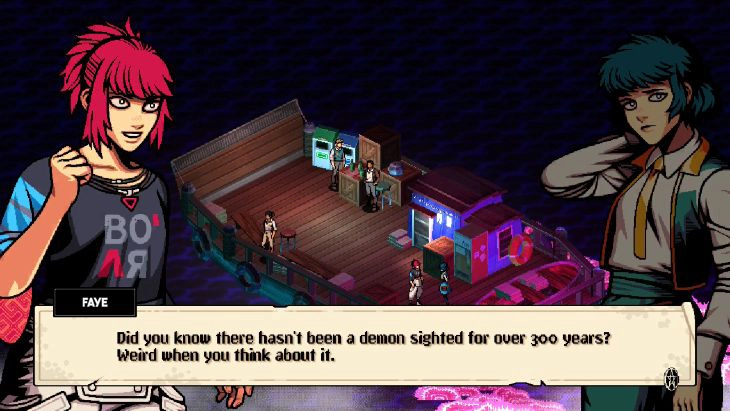
Although the end of the world is slowly getting closer as the days pass, there is a lighthearted feel to the story. On one hand, it does take a bit of tension away from the story, where it feels like major conflicts will be wrapped up easily. But on the other hand, it’s nice to have a game where, despite horrific events occurring to this group of students, they aren’t losing hope or letting the situation get the best of them.
Along with the main story beats, there are also side quests that will appear on the map as you progress through the story and interact with the different locations. The quests have you interacting with several people across the island, as well as your own tea, as you grow closer to your fellow students and island inhabitants. A lot of these quests are a part of a larger quest line, and once you wrap up the entire quest, you’ll usually get a new skill that you can equip and use in battle. When it comes to side quests starring your teammates, completing quests allows you to continue building their relationship bar.
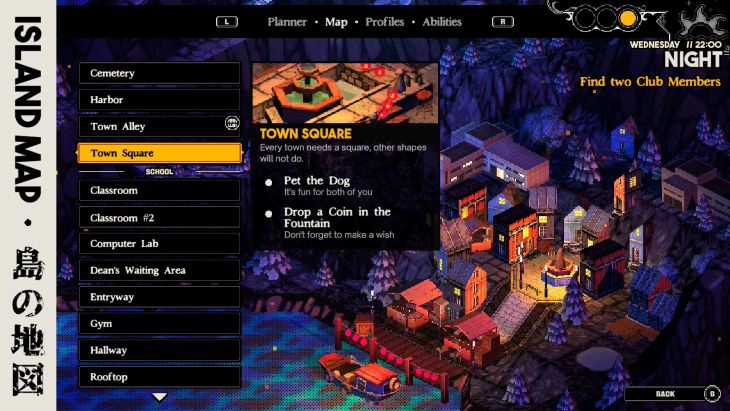
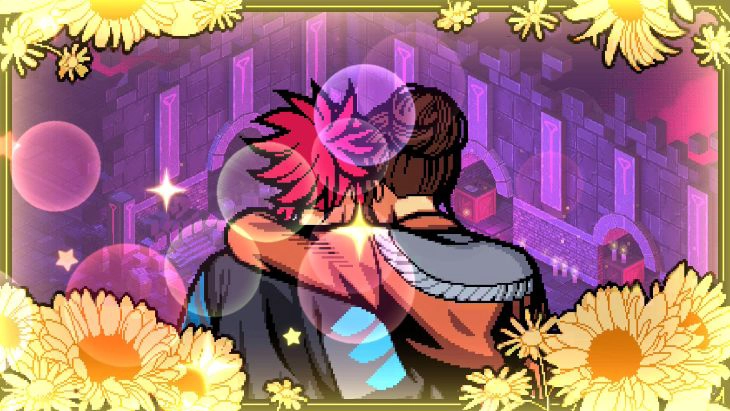
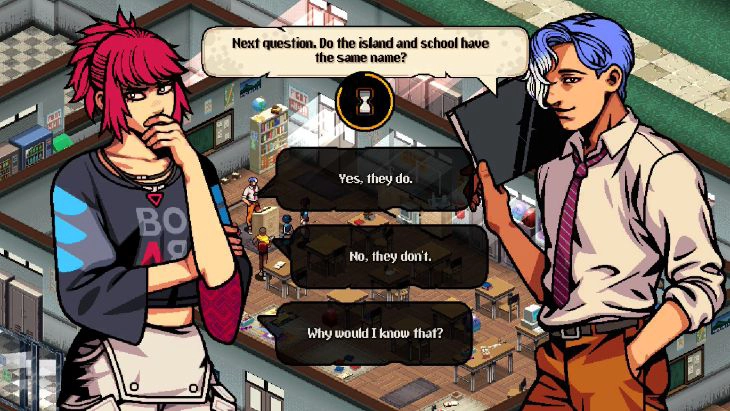
Around the town, there are a few spots where you can hang out with characters on your team and increase your relationships with them. These spots act as minigames, where you are picking the correct choice from a series of options. If you fail the minigame, there isn’t a consequence outside of just having to do the minigame over again. Once you hit the limit of your current relationship level, you’ll have to complete the next part of their quest to be able to level up further. Once you finish their quest line, the characters will give you the choice to remain friends or perhaps pursue something more.
Most of the characters themselves were fun to play as and learn more about, although some of the later cast do suffer from being introduced late into the story. It’s harder to connect to those characters given the amount of time we’ve had with other characters up until that point.
Demonschool is a strategy RPG where you can use up to four characters to battle against waves of enemies. Each character has its own typing advantages and weaknesses, as well as its own attack styles. All characters are viable in their own way, and there isn’t a right or wrong team build. There are some characters that are a lot more useful than others. Knute’s ability to both heal and boost your attack makes him a very powerful unit. And while you will be forced to use Faye in a majority of battles, her typing makes is so that she isn’t weak to (or strong against) any of the minor enemies in the story.
Outside of battle, you’ll be jumping through Hemsk Island, talking to villagers, interacting with landmarks, participating in minigames, and progressing the story. As you go further in the story, you’ll see how the island and its inhabitants change around you.
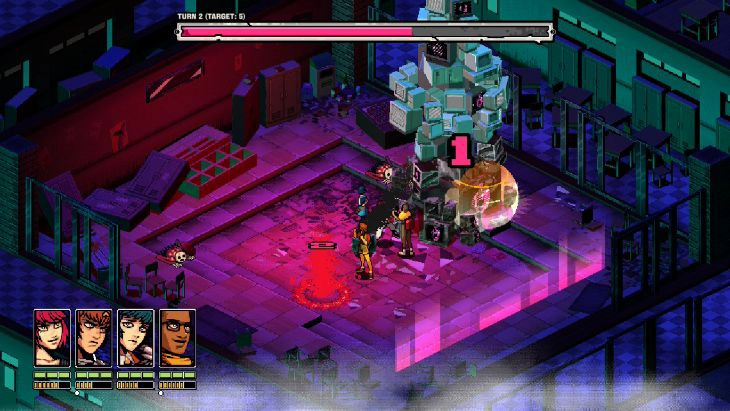
Battles take place on an isometric grid, with enemies on one end and your team on the other. Once you select and place your teammates in the order you prefer, the battle kicks off. You start off each turn with 8 AP, and with each movement or attack/support move costing 1 AP. As you use a unit, the cost of using another move increases. So, for instance, moving Namako closer to the enemies costs 1 AP. Moving her again so that she can actually attack costs 2 AP. Using her special attack, which just became available thanks to her special gauge bar filling up, costs 3 AP, and so forth. So, making use of your entire team so that one person doesn’t end up using up your entire bar in three moves is a part of the strategy.

Each battle outside of boss battles will have a set amount of enemies that you’ll need to defeat before you can seal the area and win the battle. Once you have defeated the set amount of enemies, you’ll have to navigate at least one of your units to the end of the stage in order to seal the map. There are also mission challenges that you can aim for to get a better score and earn more money, but they are not required to complete the mission.
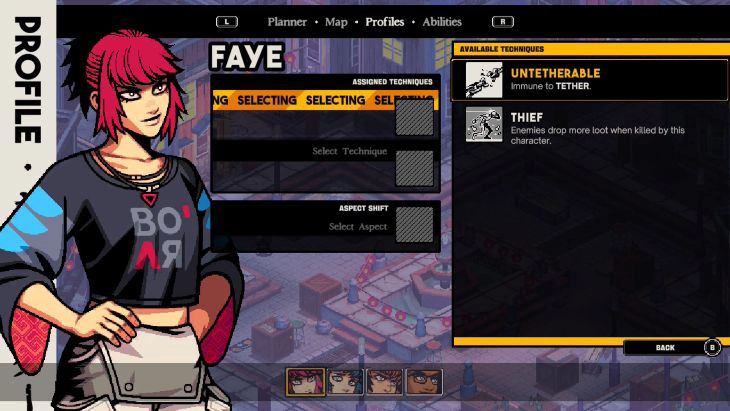
Along with each character’s general abilities, you can assign techniques that act as passive skills. The range of these skills varies, from adding poison to all of your attacks to increasing the amount of damage dealt if an enemy is knocked back into an obstacle. Selecting the right techniques for both your playstyle and the particular character makes team building interesting. Most battles are straightforward, and with the ability to play around with positioning and attacks during the planning phase before committing, you can figure out the best strategy for your turn. And if you find yourself in a real pickle, you can restart battles from the beginning, switching up your team if need be.
Along with the character’s attack, there are a lot of techniques that can be unlocked and equipped for your units. You’ll pick up techniques by completing quests, interacting with items around the island, and sometimes through the main storyline. In order to use techniques, though, you’ll have to unlock them by studying. All of your characters are able to study one technique at a time, with a cooldown period after studying where you can’t use them. Techniques give your units new abilities, such as making their attacks poisonous or making them resistant to a specific typing. You can switch around techniques as you get more used to the units and how they battle.
Demonschool mixes 2D pixel graphics with 3D environments, with the two styles mixing very well together. While the environments during battle tend to stay the same when dealing with mobs, all of the locations on the island are unique, from the town center to the graveyard to the harbor. And the stages when fighting against bosses lean into their design, resulting in some pretty gnarly set designs. The island gives a homey feel, if you ignore all of the demons that are crawling in the shadows. The character designs are just cool, each character having a multitude of sprites depending on their feelings at a point in time. And the UI helps to bring everything together, resulting in a satisfying visual experience.
Along with the great design aspects of the game, the music is just as fantastic. A majority of the soundtracks lean into a funk feel, with a mellow bass, synth, and drums. Each day of the week has its own dedicated soundtrack, and each song is great. The tracks are a mix of haunting, mysterious, and chill, almost as though you’re going through a haunted house.
Demonschool is an absolute gem when it comes to tactics games. Battles tend to be quick, and there isn’t one particular way to win a battle. The design aspects around the game are cool, leaning into the grungy dark aspect of dealing with demons while on an isolated island. And the story, while dragging a bit in some areas, was a surprisingly light and fun romp. Demonschool is definitely worth checking out, especially if you’re a fan of tactics-like combat.
Demonschool gets an 8/10.